
You step out of the doctor’s office, devastated. Your knee feels wobbly, each step uncertain. At just 47 years old, you’ve been diagnosed with Level 3 osteoarthritis.
The doctor recommends Total Knee Replacement (TKR), and you tell yourself you’ll do whatever it takes to get your life back.
But then the worst news comes.
You’re not eligible for TKR.
Another blow. Then another.
You sit there, speechless, wondering if this pain will be with you for the rest of your life.
Just when hope seems out of reach, your doctor leans forward and says:
“We have modern alternatives to TKR, if you want to try.”
Table of Contents
Introduction
In the past, patients had to endure prolonged knee pain. And
some of them had only one option which is knee replacement surgery to find
relief. Some were afraid, some were not suitable candidates, and others simply
tolerated the pain in order to continue their daily activities.
Today, modern medical advancements have opened new
possibilities. Modern alternatives to TKR (total knee replacement) surgery such as knee gel
injections, genicular nerve block (G-block) and radiofrequency ablation have
marked a new advancement in knee treatment.
However, how do these three non-invasive knee treatments
differ? And who is suitable for each treatment? In this article, we will
compare Knee Gel Injection, G-Block, and RFA so that you can make the most
appropriate choice for your knee and return to moving more comfortably.

3 Modern Alternatives to TKR (Total Knee Replacement)
What is Knee Gel Injection?
One of the modern alternatives to TKR surgery is gel injection. Knee gel injection is a treatment where hyaluronic acid, is injected into the knee joint to help reduce pain and improve movement, especially in patients with osteoarthritis.
The gel acts as a lubricant and shock absorber inside the joint, making movement smoother and reducing friction between the bones. This treatment helps relieve symptoms but does not repair structural damage in the knee, and it is often used to delay or complete other treatments such as physiotherapy or surgery.
What is G-Block?
Next modern alternatives to TKR is Genicular Nerve Block, or GNB (also known as G-block), is a modern interventional treatment used to alleviate knee pain. This procedure helps relieve knee pain in patients with osteoarthritis (OA) by targeting the nerves surrounding the knee.
As the name suggests, the treatment focuses on the genicular nerves, which are responsible for transmitting pain signals from the knee to the brain. When an anaesthetics or steroid is injected around these nerves, it interferes with the transmission of pain signals to the brain.
The result?
Patients typically experience reduced pain and improved mobility.

What is RFA?
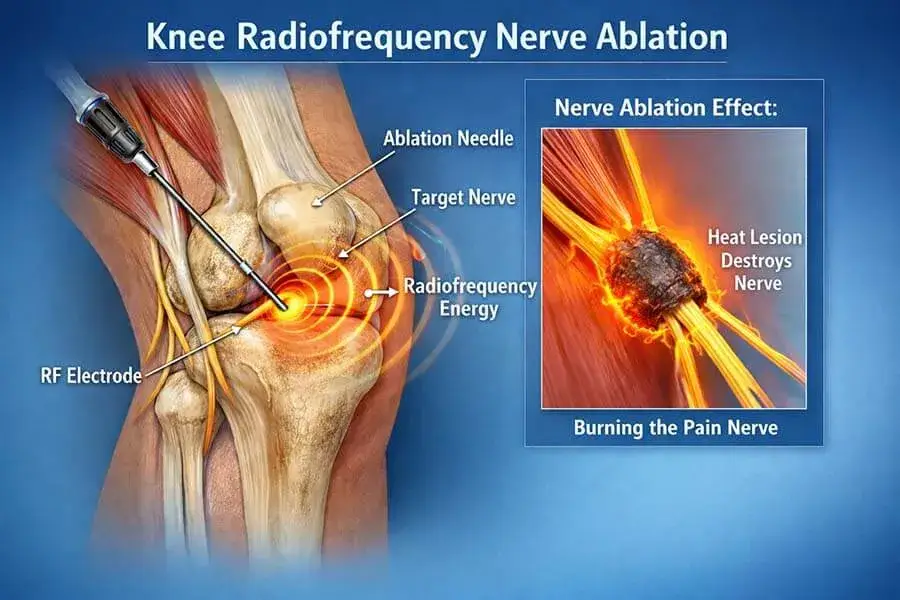
Radiofrequency Ablation (RFA) is one of the modern alternatives to TKR that uses a similar approach to GNB, but has been shown to provide longer-lasting pain relief.
RFA is also a non-invasive treatment option for patients with chronic osteoarthritis who have not found relief from conservative treatments. It can also be considered an alternative option to Total Knee Replacement (TKR) in selected patients.
RFA does not focus on repairing the structure of the knee. Instead, similar to GNB, it targets the nerves surrounding the knee. RFA disrupts pain signals from being sent to the brain using radiofrequency energy. This energy heats up the pain-transmitting nerves and causes controlled damage to the nerve tissue.
What is TKR?
Total Knee Replacement (TKR) is a surgical procedure performed to permanently replace damaged knee joints.
TKR is usually considered a last-resort treatment for patients with end-stage osteoarthritis, especially when the internal structure of the knee is severely damaged and other treatments are no longer effective, including these modern alternatives to total knee replacement.
This surgery is performed by an orthopaedic specialist. Depending on the severity of the condition, a patient may undergo either a partial or total knee replacement.
During the procedure, the damaged joint is removed and replaced with a synthetic implant, which is typically made of a titanium alloy.
TKR can help relieve knee pain, correct knee deformities such as a bent knee, and improve a patient’s mobility and overall quality of life.

Can G-Block and RFA Replace (TKR) Surgery?
G-Block and RFA are interventional treatments that can help reduce knee pain. In fact, several studies have shown that both treatments are capable of relieving knee pain in patients with moderate to severe conditions.
They can also be considered alternative options if conservative treatments such as pain medications and physiotherapy fail to provide adequate relief, with a lower risk of complications.
However, G-Block and RFA cannot fully replace Total Knee Replacement (TKR) surgery. This is because both treatments do not repair, restore, or treat structural damage within the knee joint.
Instead, G-Block and RFA work by blocking pain signals from reaching the brain through the nerves around the knee. In simple terms, they only relieve pain symptoms rather than treating the underlying cause of the problem.
In contrast, TKR addresses the knee problem internally by directly replacing the damaged joint surfaces, bone, or cartilage. This surgery provides a more permanent solution to joint damage.
In conclusion, G-Block and RFA can be modern alternatives to TKR for pain relief, whereas TKR offers a more long-term and durable solution for joint damage.

When Are G-Block / RFA Suitable as Alternatives?
- When the internal structure of the knee has not been completely damaged
- Patients who are not suitable candidates for surgery (e.g., high BMI, heart-related risks)
- Patients who do not wish to undergo surgery
- Patients who are considered too young for Total Knee Replacement (TKR)
When Is TKR More Suitable?
- When the knee joint is severely damaged or the bones are already rubbing directly against each other
- When conservative treatments and other interventions have failed
Conclusion
G-Block and RFA are interventional treatments that help control knee pain by targeting the nerves around the knee. They are suitable options for patients who are not yet ready or are not suitable to undergo surgery.
However, these procedures do not repair structural damage within the joint like Total Knee Replacement (TKR) does. The choice of treatment depends on the severity of osteoarthritis, the patient’s symptoms, and a comprehensive clinical assessment.
Proper medical evaluation and advice from a doctor are essential before making a treatment decision.
Discover all about your knee pain here: Knee Pain 101
No ONE DESERVE TO LIVE IN PAIN
Experience the Difference with Klinik Tuah’s Knee Pain Treatment